

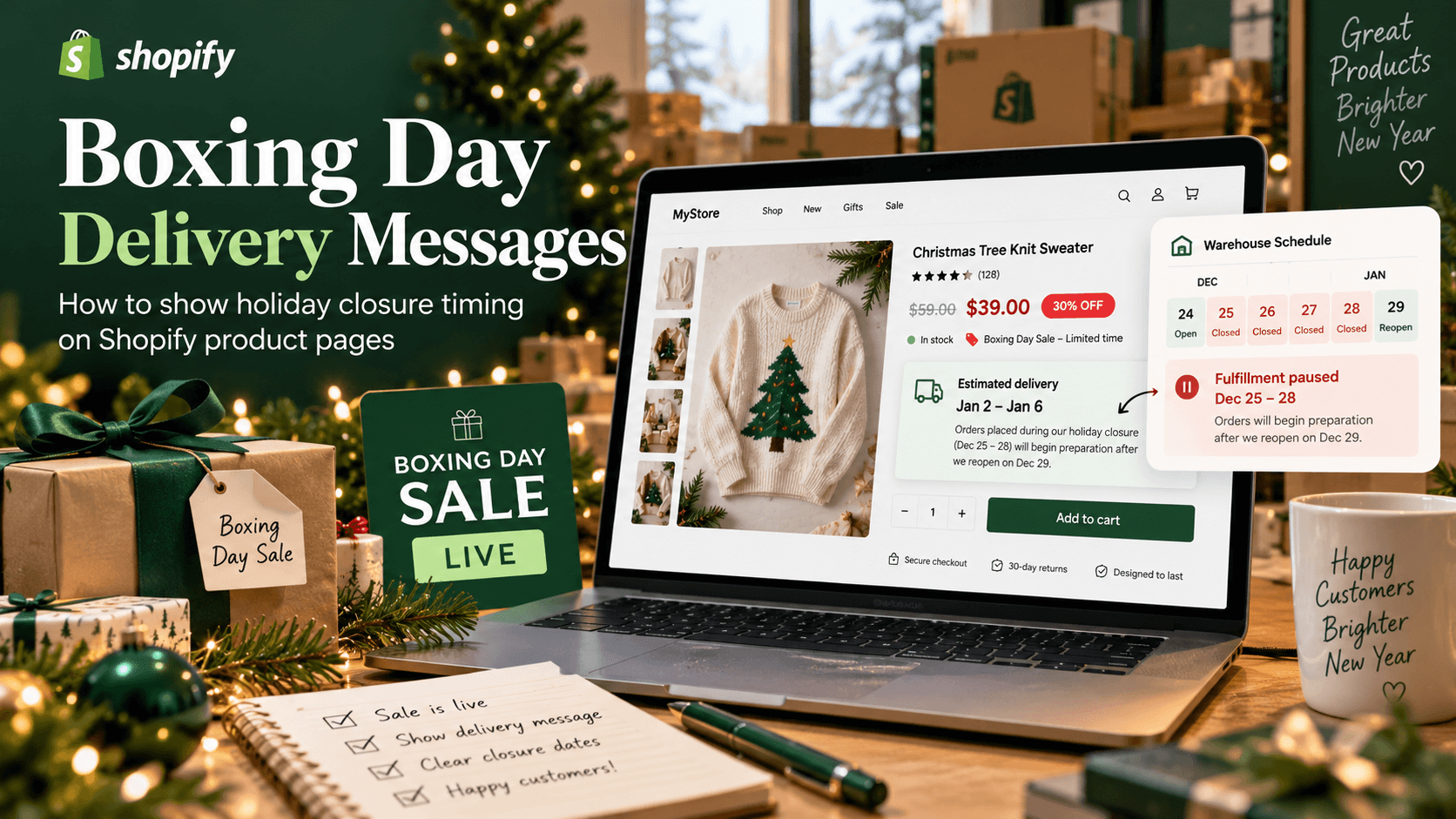
An end-of-year promotion can stay live while the people packing orders are away. A shopper may see a Boxing Day offer on December 26 and assume the order will be prepared immediately, even if your warehouse reopens several days later. Make the delay visible where they are choosing the product, and update it again when regular service resumes.
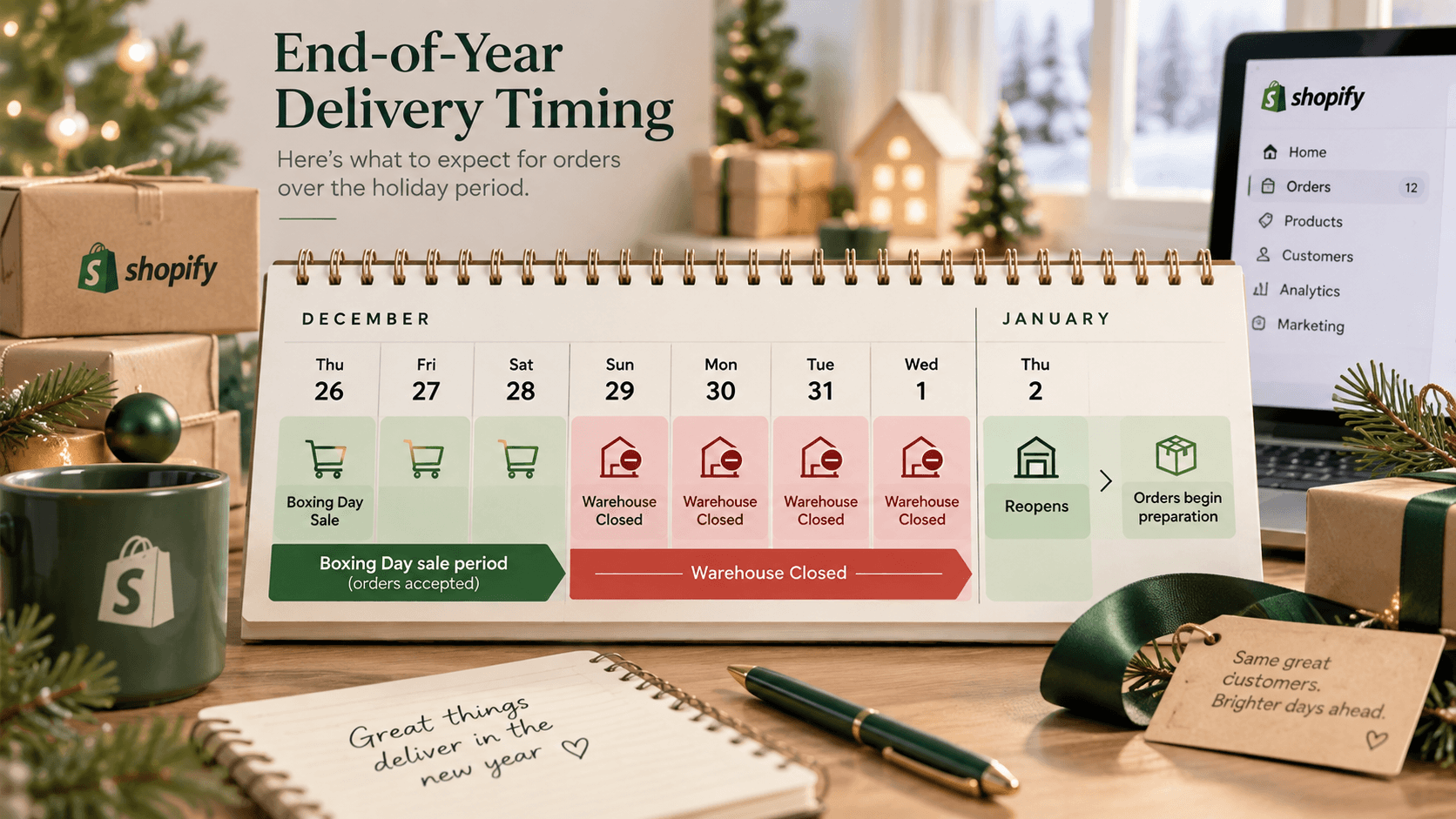
What Is an End-of-Year Delivery Message, and Why Use One?
An end-of-year delivery message explains when orders placed during a holiday closure are expected to be prepared and delivered. It might show an estimated arrival range, a note about the next preparation day, or both. For a shopper buying a gift box after Christmas, the practical question is: “If I order during this sale, when does work on my order begin?”
A clear answer helps the shopper plan without having to infer your warehouse calendar from the promotion date. It also gives your support team wording that matches the storefront. The message is an estimate, not a guarantee. In particular, a sale date does not establish a carrier's working day or transit speed.
Make the Calendar for Each Place You Serve
Boxing Day falls on December 26, but whether that day or a substitute day affects your business depends on where your staff, warehouse, and carrier operate. New Year's Day falls on January 1. Do not apply one country's holiday calendar to every order merely because the campaign runs internationally.
For one gift box, record your last normal packing day in December, every closure through reopening, your first day back, and the carrier's schedule for the shipping areas you serve. Add the daily order cutoff. If your team resumes work before the carrier does, those two dates need different treatment. Shopify recommends checking carrier holiday schedules and communicating the resulting shipping expectations.
For instance, assume a warehouse closes December 25–28 and reopens Tuesday, December 29. It ships to two areas. The warehouse closure delays preparation for orders to both. If the carrier serving Area A works December 29–31 but the service to Area B does not resume until December 30, the transit windows differ even though both boxes are packed on the same day. A single sitewide arrival date would hide that difference. Check each service's real schedule before writing location-specific copy; this example does not establish that WowETA models every combination automatically.
To make the assumed difference concrete, suppose the gift box is handed to Area A's carrier December 29, Area B's carrier December 30, and each service takes three to five further working days. Assume neither service moves parcels on January 1 or weekends. Under only those assumptions, Area A's illustrative arrival range is January 4–6, while Area B's is January 5–7. Your actual estimate needs the current service calendar and a storefront check.
Choose a Message That Fits the Closure
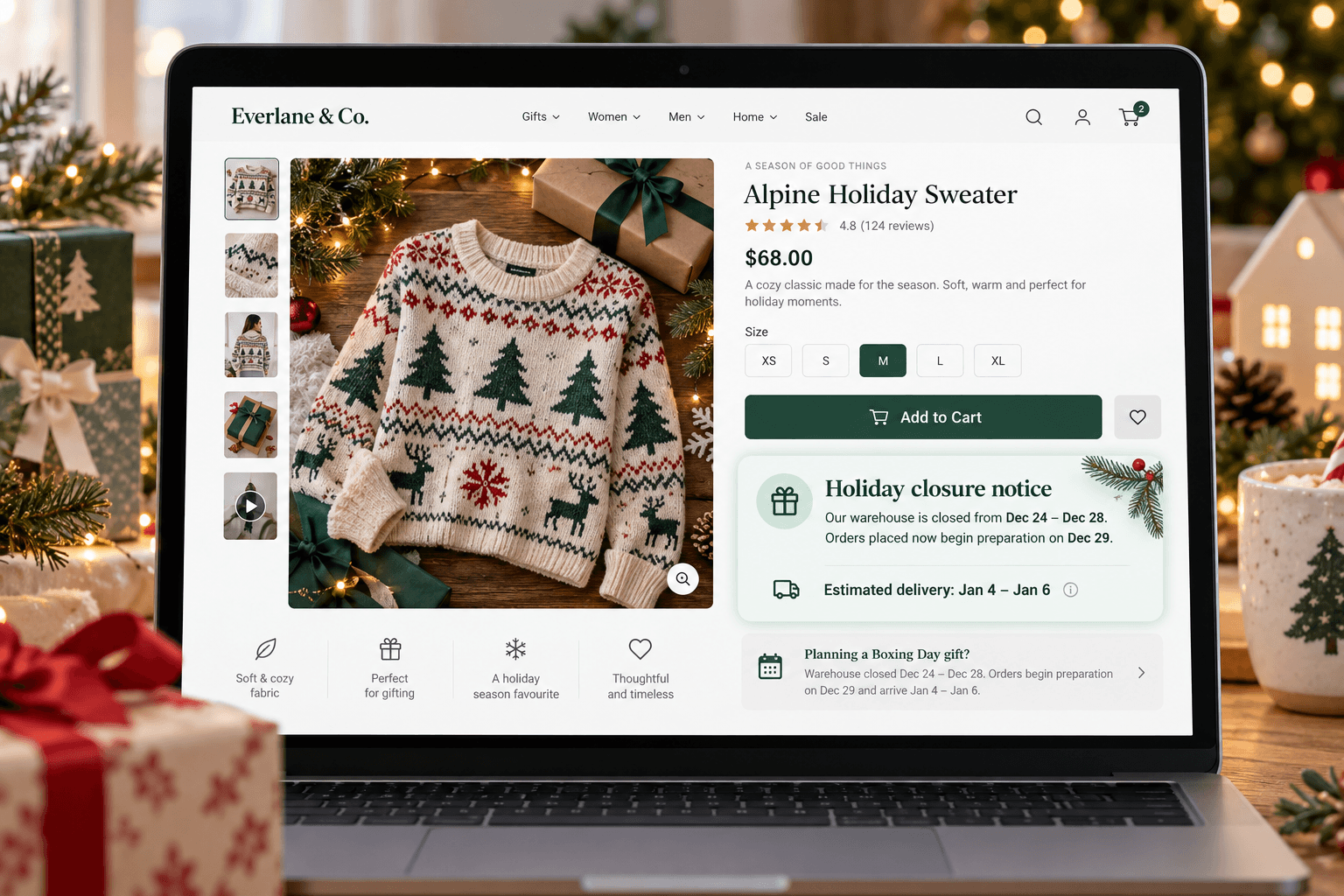
Keep promotional urgency separate from delivery timing. “Boxing Day sale ends tonight” tells shoppers when the offer ends. “Orders placed today begin preparation when our team reopens” tells them about fulfillment. Both can be true, but one does not imply the other.
| Situation | Customer-facing information to provide |
|---|---|
| Warehouse closed, orders still accepted | State the next preparation day and show the resulting estimated arrival range. |
| Warehouse open, carrier service limited | Show the current range and explain that dispatch or delivery may wait for service. |
| Different destinations have different schedules | Show a location-relevant estimate where available; avoid a universal arrival promise. |
| Regular work resumes | Remove the closure notice and recheck the normal estimate before leaving it live. |
Do not copy these as fixed storefront messages. Use your actual opening date, carrier information, and displayed estimate.
Plan the message in three phases
Before the closure, tell shoppers the last ordinary preparation day and show a date range based on orders placed then. During the closure, state when new orders will begin preparation and keep the sale message separate. After reopening, remove the closure notice only when the team has actually returned to the normal schedule; a backlog may still call for a longer preparation range.
For the gift box, that means a customer ordering during the Boxing Day sale may see a later arrival than someone who ordered before the warehouse closed. The discount can be identical while the service timing differs. That is a reason to show the estimate beside the item, not to bury it in a general holiday FAQ.
Step-by-Step Guide to Updating Your Shopify Delivery Message
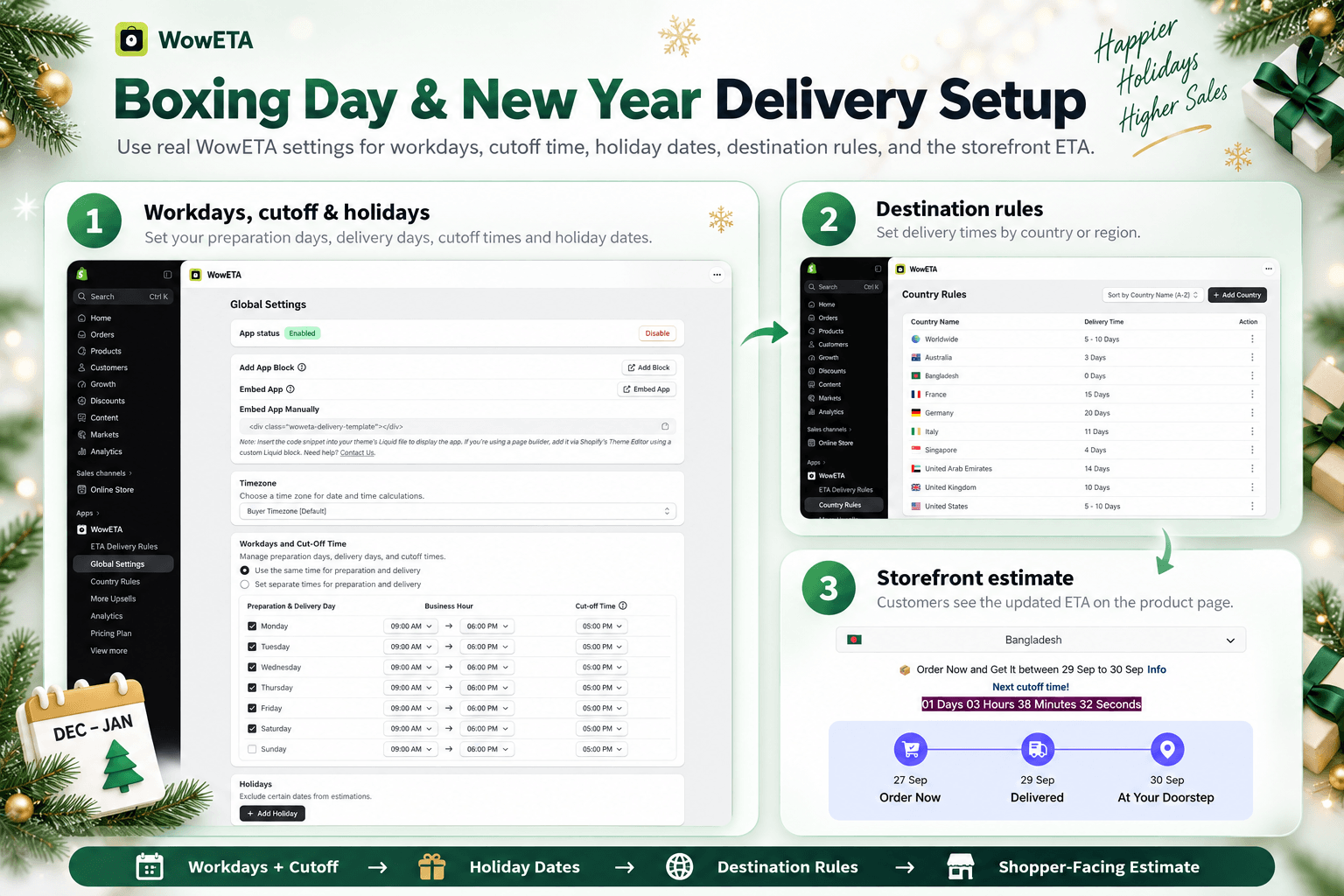
Before choosing an app, prepare the closure calendar and a reliable transit assumption for each destination. A suitable delivery-date app should account for nonworking days and display the resulting range. The example below uses WowETA Estimated Delivery Date.
1. Review working days and cutoff
Check that WowETA's regular workdays match your team schedule. Do not alter a weekly pattern just to represent a one-time year-end closure. The current App Store listing includes workdays and cutoff time on its Free plan.
2. Add holiday dates if your plan allows it
WowETA's public FAQ says configured holidays affect the delivery-date calculation. The App Store listing places Holidays and Vacations on a paid plan. Check the installed account before planning a holiday-specific rule, and preview the date rather than assuming the calendar change worked as intended.
3. Check destinations separately where needed
If you use country-specific rules, verify the country is one you actually ship to. WowETA's FAQ says the country must also be present in Shopify's shipping and delivery settings. The App Store listing assigns country and ZIP code rule sets to Advanced; confirm the current entitlement before making a location-specific promise.
Check the destination most likely to expose a mistake. If your warehouse is closed in one country while you ship to another, the shopper's local holiday calendar may differ from the warehouse's. Test a destination with different service days, then compare the result with your carrier's guidance. If the installed app or plan cannot express that distinction, keep the published wording conditional and give customers the wider expected range.
4. Read the message as a shopper
Preview the gift box on the product page during an authorized test. Check an order during the closure, one just after reopening, and a second destination if you serve one. Compare the date with your calendar, then update any banner or email that still suggests same-day processing during the closure.
Switch Back to Normal Timing Deliberately
When your team and carrier return to their usual schedule, remove outdated closure copy and recheck the displayed estimate. A stale “we reopen in January” note can confuse shoppers long after the sale. WowETA helps show the window, but the merchant must keep the working calendar and customer message aligned with the business's actual schedule.
Put the reopening review on a calendar now. Check the product page, a sale collection, any announcement banner, and the shipping policy on the same day. One updated widget cannot compensate for an old statement elsewhere that still tells shoppers their orders are waiting for a team that has already returned.
Wording That Helps During Each Phase
For the hypothetical warehouse above, three customer-facing lines could be:
| Phase | Example message for the same gift box |
|---|---|
| Before closure | “Orders placed after our December 24 processing cutoff begin preparation December 29. Check the displayed estimated arrival for your area.” |
| During closure | “Orders placed during our December 25–28 closure begin preparation December 29. Estimated arrival to Area A: January 4–6.” |
| After reopening | “We're preparing new orders again. Check the updated estimated arrival for your area.” |
The dates in this table come from the illustrative Area A assumptions above; replace them with your actual product and destination estimate. A reopening date alone does not include transit. These are wording examples for the assumed shop, not verified WowETA output.
Keep the offer language in a separate sentence. “Boxing Day offer ends tonight” can coexist with a later preparation date, but combining them into “order tonight for fast delivery” would imply a connection you have not established. Read the final message as a buyer unfamiliar with your holiday schedule: it should answer when work starts and when the parcel might arrive.