

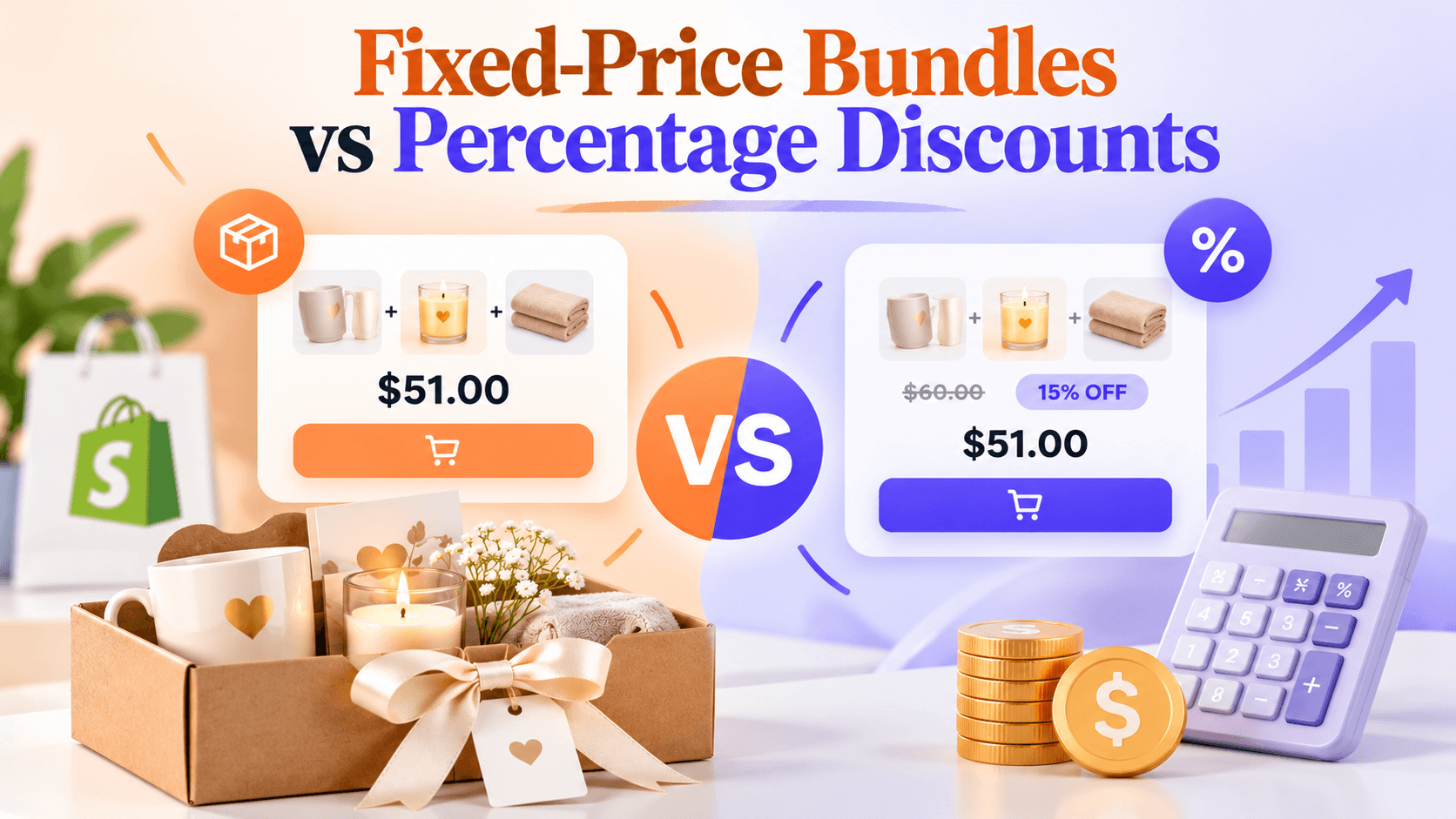
Comparing a fixed-price bundle vs percentage discount? Choose a fixed-price bundle when you want a specific pack to sell for one clear total. Choose a percentage discount when the saving should scale with the prices of the selected items.
Neither is automatically more profitable. The difference becomes important when shoppers choose higher-priced variants, your catalog prices change, or the cost of filling the bundle rises.
There’s also an easy mistake to avoid: a fixed amount off each item is not a fixed price for the whole pack.
Compare the four price rules on the same basket
Suppose you sell three items at $20 each. Their combined regular price is $60. The following is an illustrative USD example, excluding tax and shipping:
| Price rule | Calculation | Pack price | What stays fixed? |
|---|---|---|---|
| No discount | $20 + $20 + $20 | $60 | No reduction is applied |
| 15% off | $60 × 85% | $51 | The discount rate |
| $3 off each | $60 − (3 × $3) | $51 | The reduction per eligible item |
| Fixed pack price | Set the pack total to $51 | $51 | The pack total |
The three discounted offers produce the same initial result. That does not make the rules interchangeable.
“Save $3 on every item” commits you to a reduction. “Three for $51” commits you to a total. A shopper may understand both, but your pricing system needs the correct instruction.
Change the selected prices and the offers separate
Keep the same three-item quantity, but let the shopper choose items priced at $20, $25 and $30. The regular total is now $75.
| Same rule | New pack price | Saving against $75 |
|---|---|---|
| 15% off | $63.75 | $11.25, or 15% |
| $3 off each | $66 | $9, or 12% |
| Fixed pack price of $51 | $51 | $24, or 32% |
These illustrative totals show how the rules differ; check the allowed selections and prices in your chosen app.
The fixed-price deal now gives a much deeper effective discount. If those selections also cost more to supply, you receive the same $51 while spending more to fulfill the order. Check actual costs rather than assuming that retail prices tell you the margin.
This is why a fixed-price offer needs a carefully defined selection. “Any three” is a bigger commitment than “these three.”
When a fixed price makes sense
A fixed total is useful when you want the offer to read as one purchase: a specific starter kit, a gift set or a clearly defined multipack.
It is a reasonable choice when:
- The included items and quantities are controlled.
- You have checked every allowed variant combination against your costs.
- The total remains attractive beside buying those exact items separately.
- You are prepared to revisit the price when costs or the eligible selection change.
A fixed bundle and a fixed-price bundle describe different things. The first refers to predetermined contents. The second refers to the price rule. A predetermined set can still use a percentage discount.
If you allow several choices, calculate the most expensive combination to fulfill before approving the price. The average combination can hide an unprofitable edge case.
When percentage off is more practical
A percentage is easier to maintain when the selected basket value varies and you want a consistent relative saving.
For example, 10% off a $40 selection saves $4. The same rule on a $70 selection saves $7. The customer pays more for the higher-priced selection instead of receiving it at the original pack total.
That does not guarantee a constant margin. Two variants can have different cost structures even when the same percentage applies. It also does not prove that every app automatically updates all existing bundle prices when a component changes.
Shopify specifically states that changing a component’s price does not automatically update the bundle price in the Shopify Bundles app. That is an app-specific maintenance rule, so check the behavior of the tool you actually use. Shopify Bundles guidance.
For an example of different-priced variants and their selected pack total, see our Shopify bundle variants guide.
Quick choice: Use a fixed total for a tightly controlled pack. Use a percentage when selected prices vary. Use an amount off each when the offer promises a specific reduction per eligible unit. Compare all three against the same cost floor.
Match the decision to WowBundle’s controls
One way to show these four price modes on a product page is a WowBundle Volume tier. Choose No discount, % off, Amount off each or Fixed price, then check the actual checkout total.
Each screenshot uses a different demo product to show the relevant price setting. Demo prices are in US dollars ($).
Percentage off
The hand-wash pair uses quantity 2, % off, and a discount of 10. At $1,200 per item, the displayed pair total is $2,160.
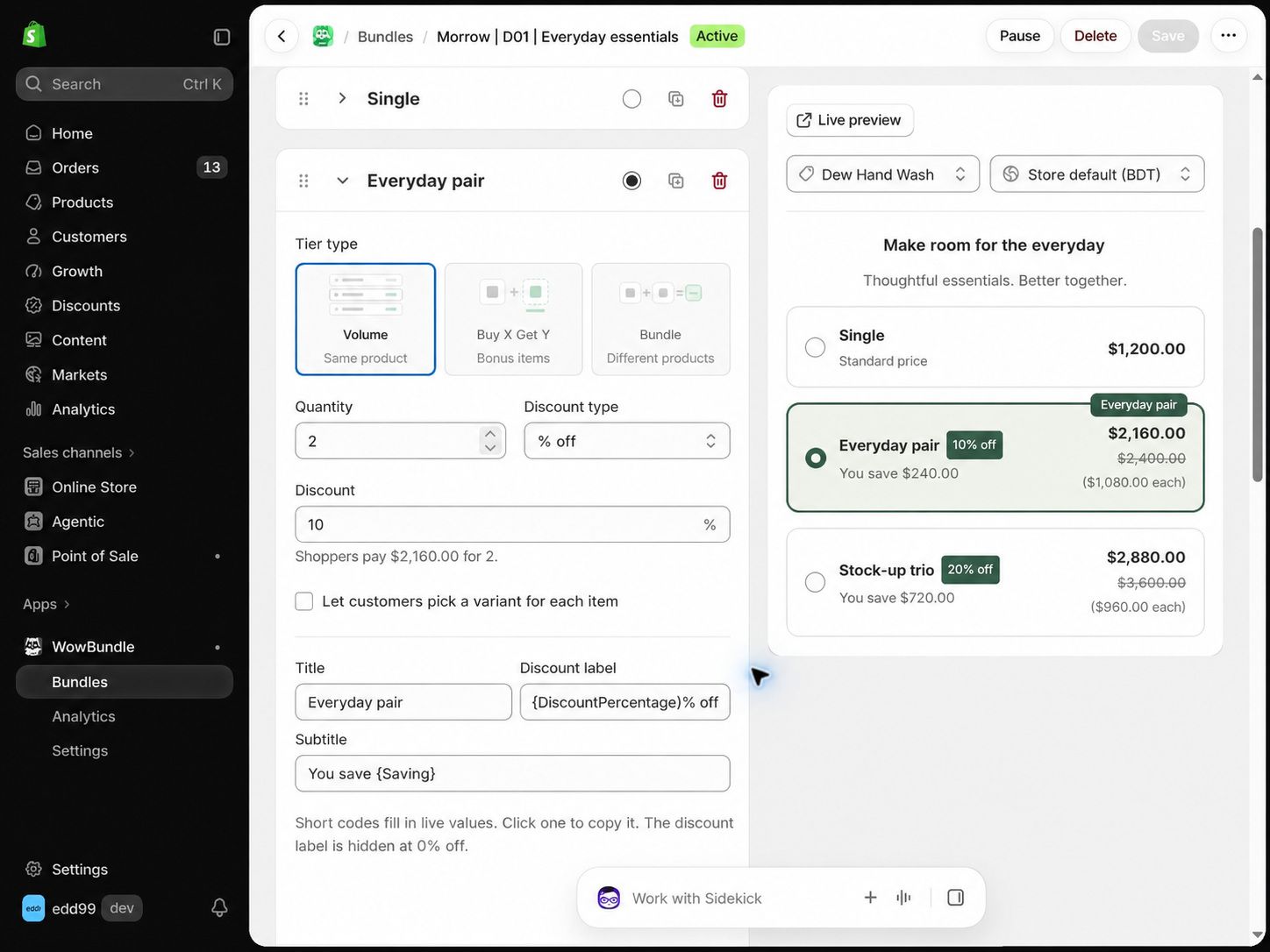
The percentage determines the reduction from the selected items’ prices.
Amount off each
The napkin offer uses quantity 4 and Amount off each of $100. Four napkins at $500 each become four at $400, totaling $1,600.
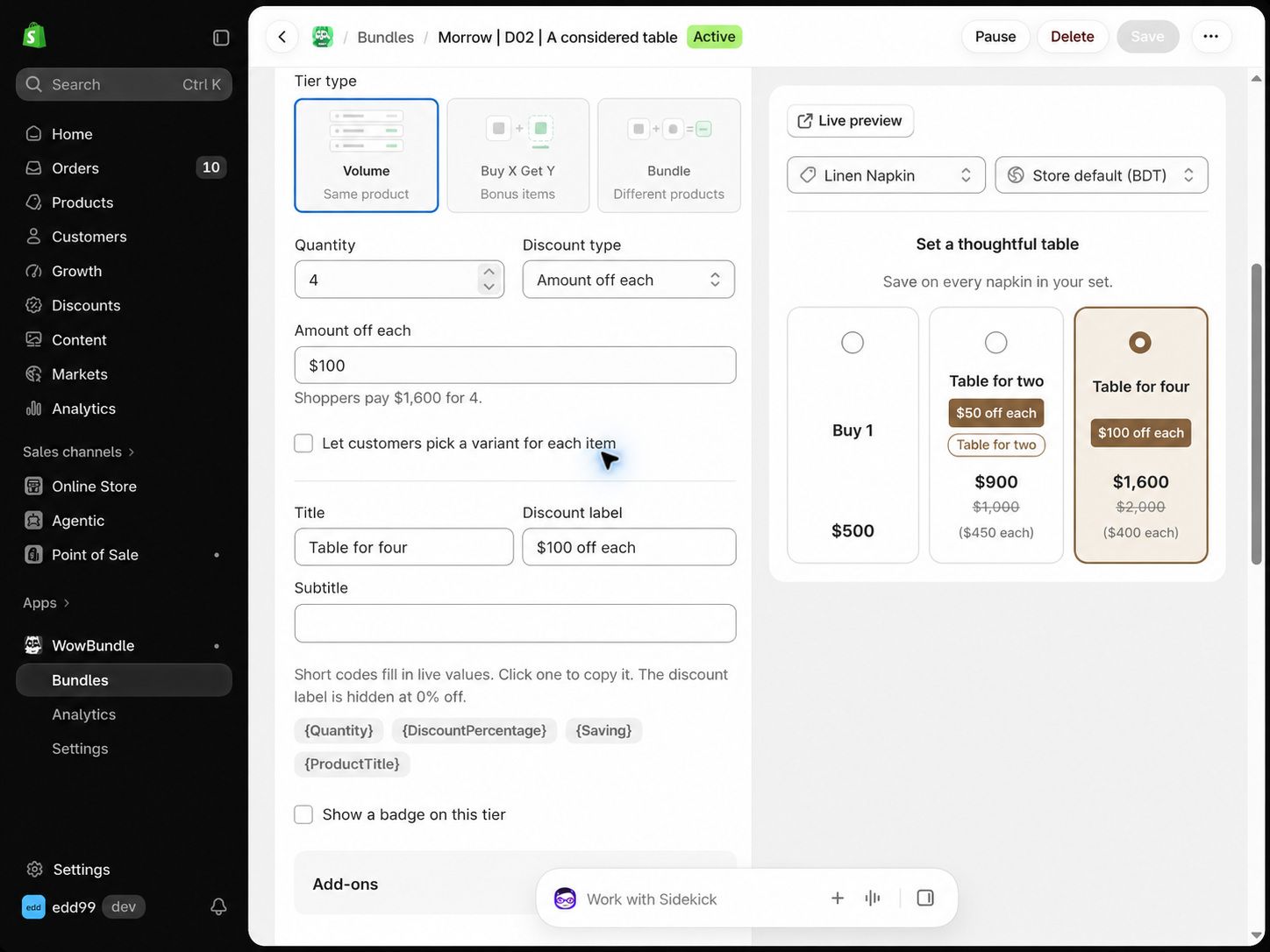
$100 comes off each eligible napkin. The pack saves $400 in this example.
Fixed price
The notebook offer uses quantity 3, Fixed price, and Price for all 3 of $2,100. The field expects the total for the pack, not the price of one notebook.
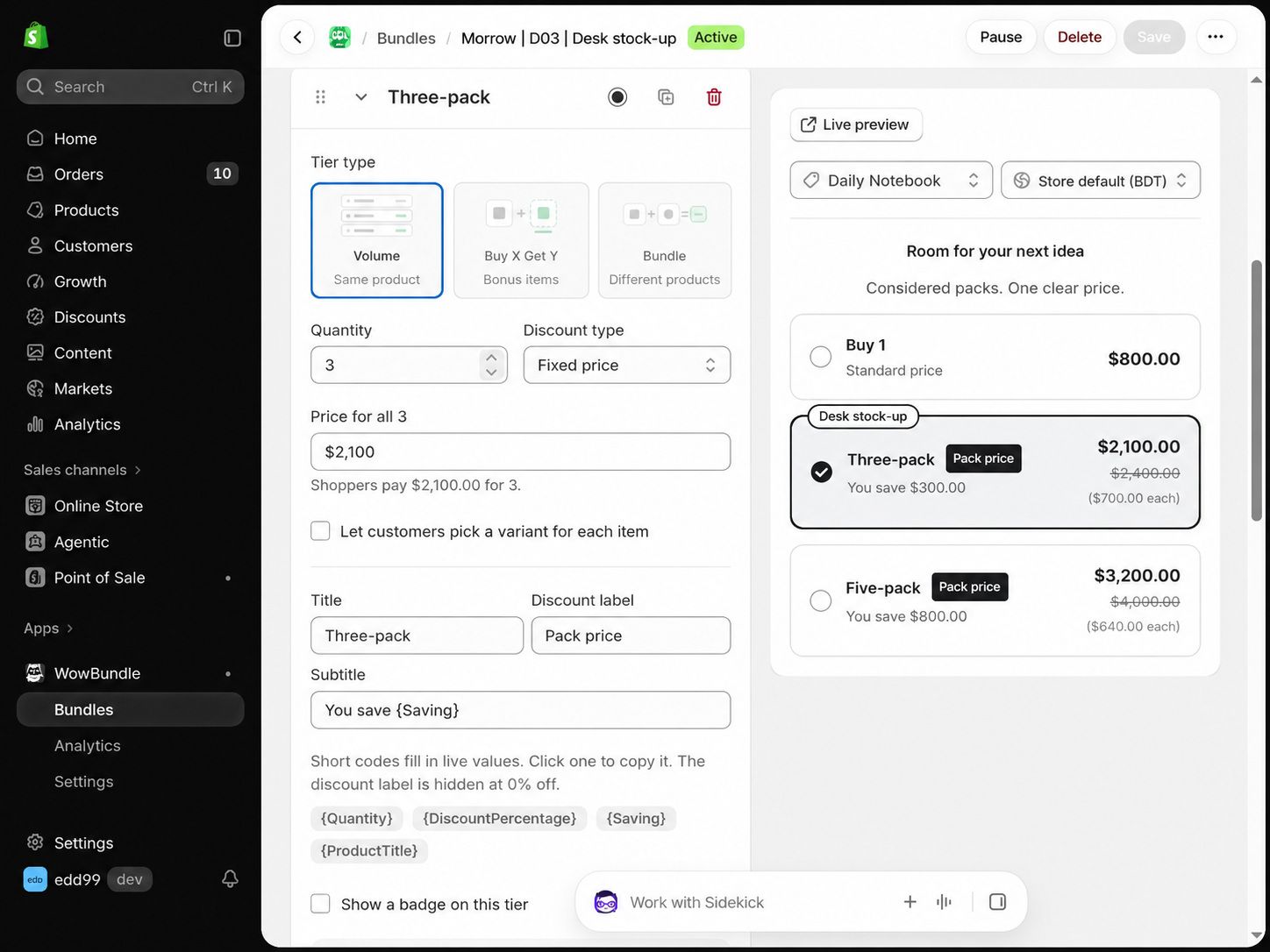
The three-notebook pack is $2,100, compared with $2,400 for three at their regular prices.
The fixed-price example covers the stated three-notebook pack only. If a shopper can enter four or five, test those quantities separately. Do not multiply or divide a saved tier price to predict the app's final checkout calculation.
Use No discount when you want a regular-price option alongside the offer. For the full targeting and launch workflow, follow the quantity-break setup guide.
Check the cost floor and the savings claim
Start with the money the order needs to leave behind, not a supposedly ideal discount percentage.
Include the product cost of every item, plus relevant packaging, fulfillment, payment fees, shipping subsidy and expected return costs. The money left after these variable costs is the order’s contribution. It must still help pay overhead and any costs you left out, so it is not net profit. Shopify’s break-even guide explains that distinction between variable costs, contribution and fixed expenses.
Use our bundle discount planning guide to work through your own costs and assumptions. The calculation cannot predict how many people will buy.
Then check the comparison shown to shoppers:
- Compare the pack with the actual standalone prices of the same selected items.
- If prices vary, recalculate the saving for the selected combination.
- Keep a fixed reduction, a fixed total and a percentage clearly labeled.
- Do not assume an editor’s headline saving establishes the final cart result.
Native Shopify fixed-amount discounts have their own settings, including whether a reduction applies once per order. Do not equate that setting with WowBundle’s Amount off each or a final pack price. See Shopify’s amount-off discount documentation.
Choose the price rule that fits your offer
For a controlled pack with a clear total-price promise, start with a fixed price. For selections with varying values, a percentage is often the simpler rule to maintain. Build the rule in WowBundle and confirm the selected pack’s price in the cart before promoting it on your store.