

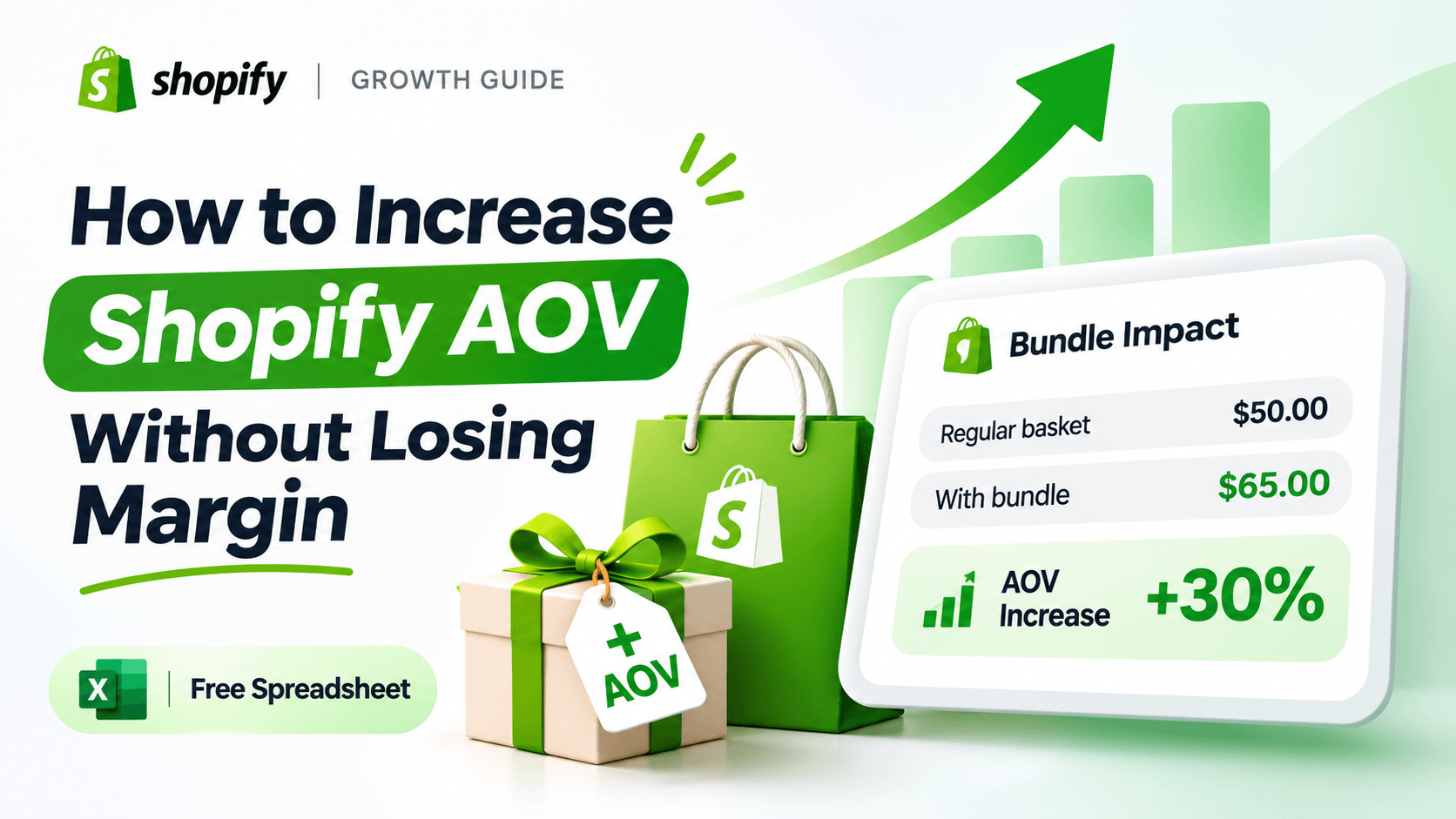
To increase average order value on Shopify, give customers a useful reason to buy more: a complete set, a sensible quantity break, a relevant extra or a reachable reward. Then check what the larger order costs you.
A $65 basket can leave you with less money than a $50 basket once product costs, discounts and shipping are accounted for. The goal is to make each shopping visit more valuable while keeping the offer easy to understand.
Start with one product or customer group. That makes it easier to see which change helps and which simply makes the cart bigger.
Four AOV tactics and what to measure
| Tactic | Customer reason to buy | Primary measure | Margin check |
|---|---|---|---|
| Quantity tier | Replenish more in one order | Units per qualifying order | Contribution after the tier discount |
| Complementary set | Finish a task in one purchase | Attach rate of the second product | Cost of each component |
| Gift threshold | Earn a useful small reward | Qualified orders vs eligible visits | Reward cost and shipping subsidy |
| Optional accessory | Add something relevant only if needed | Accepted add-ons per eligible order | Accessory contribution and returns |
Start with the customer's buying task. Use the discount calculator for a cost floor and the bundle measurement guide for post-launch tracking.
Start with the right Shopify AOV number
Shopify defines average order value as gross sales minus discounts, divided by orders, excluding post-order adjustments. Use the same dates and filters for both parts of the calculation. Shopify's analytics definitions
Shopify AOV = (gross sales − discounts) ÷ orders
For a hypothetical store with $12,000 in gross sales, $1,000 in discounts and 220 orders, AOV is $50:
($12,000 − $1,000) ÷ 220 = $50
Don't substitute the dashboard's Total Sales figure and expect the same answer. That is a different measure. Also, because Shopify's AOV excludes later adjustments, review returns and refunds separately when deciding whether an offer is profitable.
Before changing an offer, note your baseline:
- The date range, currency and sales channel
- AOV and purchase conversion for the audience you're targeting
- Product costs and variable costs of fulfilling those orders
- The common basket sizes, not just the average
- New versus returning customer behavior
A handful of large orders can make the average look less attainable than a typical purchase. As a hypothetical illustration, orders of $30, $30, $35, $40 and $165 average $60, but the middle order is $35. A shipping threshold built only around the $60 average could miss the needs of most of those buyers.
For a fuller reporting walkthrough, see how to measure Shopify bundle performance.
Choose an AOV strategy that fits the purchase
Start with the reason a customer would want the extra item. The right tactic should make their purchase more useful, easier or better value.
Bundle a complete use case
A useful bundle solves one recognizable problem. It gives the customer a reason to choose the set beyond “there are more products in it.”
For example, a hypothetical pet store could pair a walking lead with a matching waste-bag holder and a refill roll. Explain what each item contributes, show the combined price and keep the individual products easy to understand.
You don't always need a discount. Convenience, compatible items and clear guidance can make a set worthwhile at regular prices. If you do reduce the price, calculate the cost of the whole set first.
WowBundle supports predetermined mixed-product offers. That can suit a set you've already chosen. A customer-built box with freely interchangeable products is a different requirement and needs its own capability check.
Offer a sensible quantity break
Quantity discounts are most natural when customers can realistically use more than one unit: refills, socks, pet supplies or a product shared across a household.
Keep the next quantity believable. A shopper trying a new shampoo may consider two bottles but have little reason to commit to six. Existing customers who already know the product may respond differently.
Show both the pack total and the per-item price where they help the decision. A lower unit price doesn't remove the customer's need to pay more today.
WowBundle's Volume controls support percentage savings, an amount off each item and a fixed tier total, as well as no-discount choices. Choose the pricing format that makes the offer clearest, then use the quantity-tier guide to check the numbers.
Watch the next purchase too. A customer stocking up now may reorder later. That can still be useful, but an earlier purchase isn't automatically extra long-term demand.
Recommend one useful add-on or upgrade
A cross-sell adds a complementary item. An upsell helps the buyer choose a more suitable higher-value version. Both work best when the reason is obvious.
As a hypothetical example, a $9 collapsible bowl may be an understandable extra beside a $48 pet carrier. A premium carrier with stronger materials is an upgrade decision. Those are different offers, so don't present both as an unexplained list of more expensive products.
Keep optional extras clearly optional. State the added price near the choice and avoid making the customer untangle several overlapping offers.
An add-on that needs a long specification comparison may belong earlier in the shopping journey. At the cart stage, favor something the buyer can assess quickly.
Set a shipping or gift threshold shoppers can reach
A threshold works only if the reward is useful and the customer has a reasonable way to reach it.
Look at actual basket sizes and the prices of relevant extras. If a common basket is $42 and an appropriate add-on costs $12, a $50 threshold is reachable with one useful addition. These are hypothetical values, not a recommended threshold for every store.
Then check the cost. Free shipping creates a subsidy you must fund. A free gift uses stock and can add packing or shipping expense. Customers who already spend above the threshold may receive the reward without increasing their order at all.
Budget simultaneous incentives together. A product discount plus a gift costs more than either one alone.
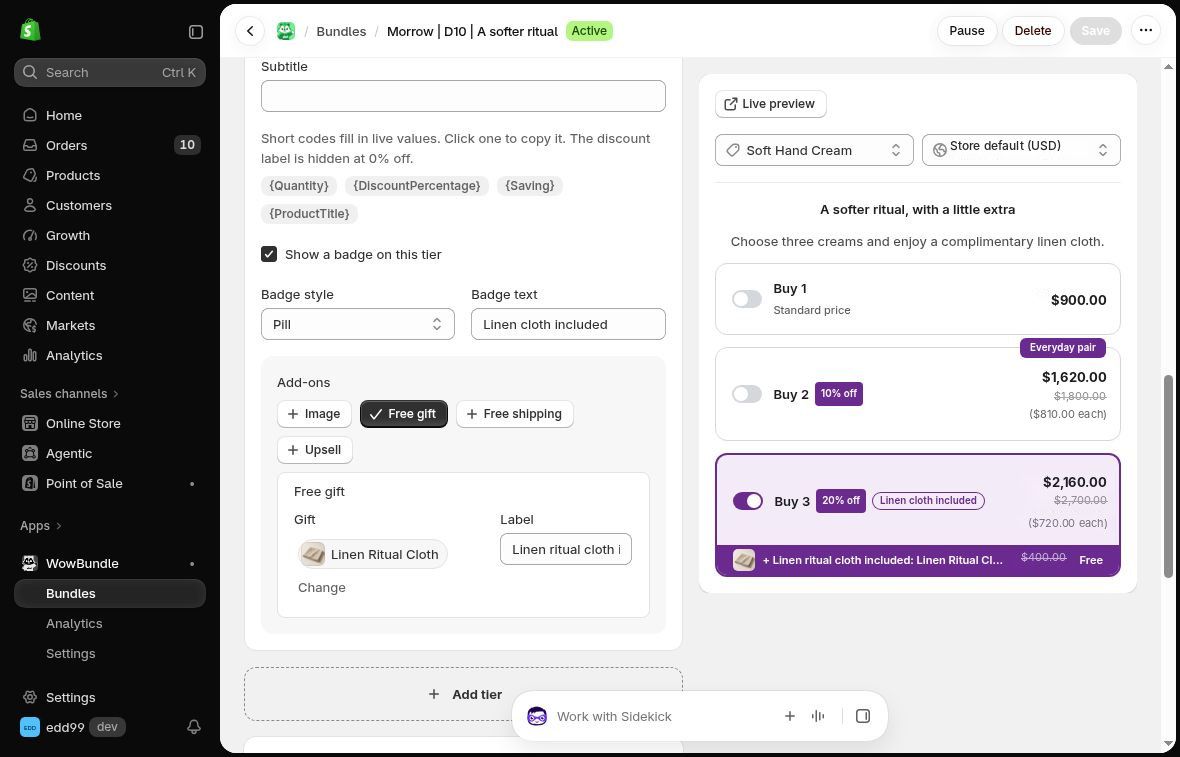
This WowBundle demo combines a three-item discount with a cloth gift. The $2,160 total is in USD. The editor preview illustrates the offer structure, not a sales result.
Treat rules such as “set free shipping 30% above AOV” as starting ideas to evaluate, rather than requirements. Basket distribution, add-on prices and shipping costs are more useful inputs than a universal percentage.
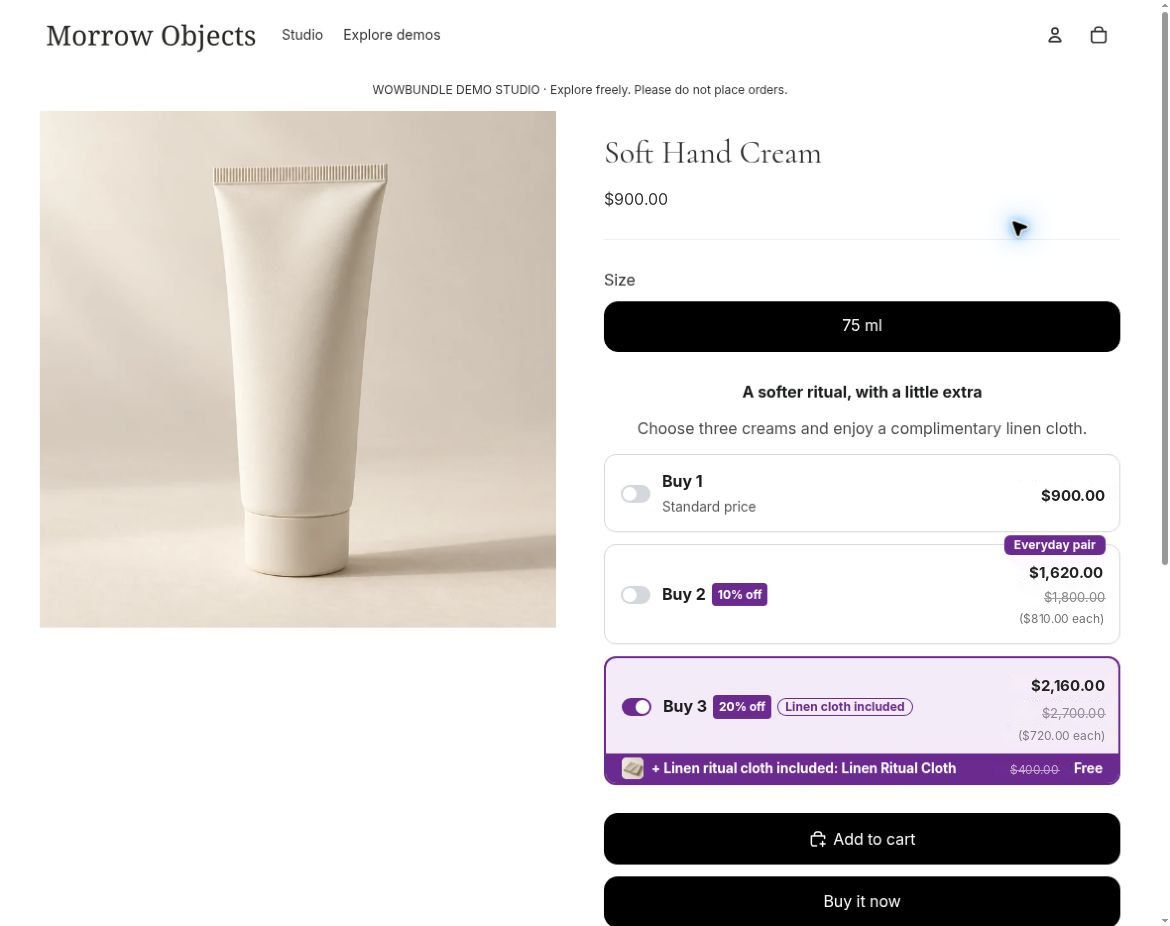
The product page shows the three-cream offer at $2,160 USD, with the cloth included free.
Use loyalty and replenishment offers for repeat buyers
Loyalty rewards can give an existing customer a reason to consolidate purchases or choose a larger order. Replenishment offers can also make buying a familiar product more convenient.
Keep order size and customer value separate. A subscription discount might reduce the first order's value while increasing later purchases. A large stock-up order might delay the next one. Track the behavior you actually want to improve instead of assuming every retention tactic will lift AOV.
For a first experiment, you may not need a new loyalty system. A clearer bundle or a more useful add-on is easier to evaluate when your main problem is a small basket today.
Check contribution before launching the offer
Calculate how much each order leaves after the costs that change when you sell it.
For this decision, define a simple custom contribution measure:
Product revenue after discounts − product cost − payment fees − variable fulfillment cost − shipping subsidy
Shipping subsidy means the shipping cost you pay, less shipping income collected from the customer. Include gift stock and additional packaging in the relevant costs.
This is a custom operating calculation. Shopify's gross profit metric subtracts cost of goods sold from net sales; it doesn't use this fuller list of variable costs. Shopify's gross profit definition
Here is a hypothetical USD comparison. These are illustrative inputs, including the payment fees, not standard Shopify rates or a real merchant result.
| Per-order amount | Current purchase | Proposed bundle |
|---|---|---|
| Product revenue after discounts | $50.00 | $65.00 |
| Product cost | $18.00 | $31.00 |
| Payment fees | $1.80 | $2.25 |
| Variable fulfillment cost | $4.00 | $5.00 |
| Shipping subsidy | $0.00 | $6.00 |
| Contribution before advertising and fixed costs | $26.20 | $20.75 |
The order value rises 30%, but contribution per order falls by $5.45. The larger basket carries more product cost and a shipping subsidy.
That doesn't mean the offer can never work. It means the extra revenue alone doesn't justify it. You might need a smaller discount, a different companion product, a less expensive reward or better conversion.
The simplified table excludes taxes, advertising, fixed overhead and later refunds. Add the costs relevant to your decision and review actual returns as they arrive. Use the bundle discount calculator before setting a price, and compare fixed-price versus percentage offers if your variants have different costs.
Include visitors who leave without buying
Compare the money left after costs across all visits included in the comparison, including visits that do not produce an order. This is your contribution per eligible session.
Continuing the same hypothetical example, suppose the current purchase converts 3% of eligible sessions. At $26.20 contribution per order, 1,000 eligible sessions produce $786 in contribution.
If the bundle converts 2.8% at $20.75 contribution per order, the same 1,000 eligible sessions produce $581.
The bundle has higher AOV, yet leaves $205 less contribution from the same-sized audience. Count orders from the same group of visits on both sides. For example, if the comparison includes visitors to one refill product page, use orders from those visits rather than all store orders.
Contribution per session helps you weigh order size and purchase rate together. It is still subject to later returns and any costs left outside your model.
What a real merchant example shows
Shopify's historical LVLY case study reports a 6% year-over-year AOV increase after a broader replatforming and customer-experience program. The story discusses bundles, optional add-ons, subscriptions and gift vouchers, with the migration and subsequent events taking place in 2022–2023. LVLY's Shopify case study
The useful lesson is the merchandising approach: help a gift buyer build a purchase that fits the occasion.
The case doesn't isolate the effect of a bundle, establish a contribution-margin improvement or involve WowBundle. Use it as an example of useful customer choices, not as a prediction that your own offer should produce a 6% lift.
Compare the offer with a clear baseline
Compare the offer with purchases from the same product, market, channel and customer group. For example, compare a refill product’s ordinary purchase pattern with the period when customers can choose a two-pack. Record changes in advertising, stock and seasonal demand so they do not get mistaken for the effect of the offer.
Keep the main change clear. A quantity offer, companion product and reward launched together make the result harder to explain. Include the app charge and all relevant product, gift and fulfillment costs when comparing what the orders leave your business.
Read AOV alongside purchase conversion and contribution per eligible session. Review customer questions, returns and fulfillment costs too. The amount of evidence you need depends on traffic and how much results vary; a fixed number of days does not make a comparison reliable.
For replenishable products, include the normal next-purchase opportunity. A larger order may have brought the customer’s next purchase forward rather than increased what they buy overall. If you need to measure the offer’s causal effect, a separate experiment tool can compare randomly assigned visitors who see it with a control group who do not.
If you use Shopify Analytics sessions or conversion rate, choose a baseline after its September 21–23, 2026 measurement update. Reported conversion can change without a change in orders or sales. Keep the Human or bot session filter consistent where available, but don't treat matching filters as making pre-update and post-update sessions comparable. Shopify's session measurement update
Avoid comparing people who accepted a bundle with everyone who didn't. Those groups made different choices, so the higher AOV of bundle buyers doesn't tell you what the offer caused.
Likewise, an app's attributed bundle sales are useful for understanding activity, but they aren't automatically incremental sales. Keep the offer only when the broader comparison supports it.
Common questions about Shopify AOV
What is a good AOV for a Shopify store?
There isn't one useful number for every store. Product prices, category, purchase frequency and customer mix all matter. Start with your own comparable baseline and ask whether the orders produce enough contribution to support the business.
Does buy one, get one free automatically increase AOV?
No. If someone would have bought one $30 item and instead receives two for the same $30, units per order rise while revenue for that order stays the same. The free item also adds cost. A different qualifying quantity could change the economics, so calculate the exact offer.
Build the first offer
Choose one purchase to improve. For a refill customers regularly use, try a clear two-pack. For a complete use case, choose a preset set of related products. Explore WowBundle to build the offer, then follow the matching setup guide and compare results using your own order and cost data.